EconomyMedium
Denmark says Russia could hit a NATO country within months. Here's why Nigeria should care.
Danish intelligence warns of a low but growing risk Russia attacks a NATO country. What it means for oil, wheat and Nigeria's budget.
By Betini Udom Published 4 min read Editorial Policy Report a correction
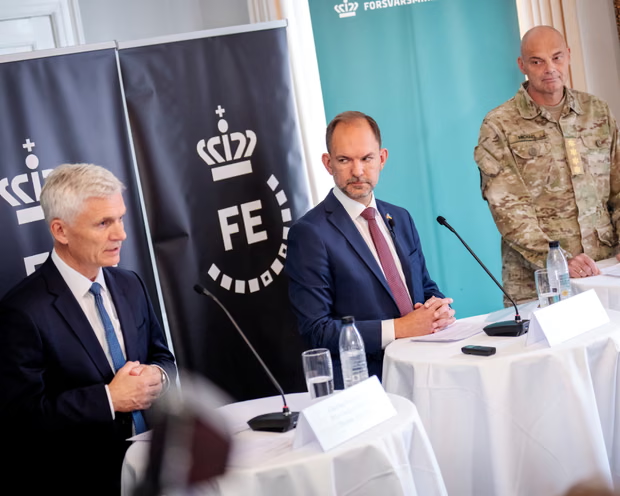
The Danish Defence Intelligence Service published a new risk assessment on 24 September. Its central judgement is that Russia might strike NATO infrastructure being used to support Ukraine, or push small numbers of troops across a border — possibly soldiers wearing no national insignia, so that nobody can immediately prove who they are.
A full invasion of a NATO country, the service said, remains highly unlikely. But it stopped short of ruling it out. The head of the service, Thomas Ahrenkiel, presented the findings alongside Denmark's defence minister, Jeppe Bruus, and its chief of defence, Michael Hyldgaard.
What exactly is being warned about?
Three different things, and they are worth separating.
Strikes on infrastructure. Roads, rail, depots and communication links inside NATO countries that are used to move support into Ukraine.
Small, deniable incursions. A limited number of troops crossing a border, potentially without insignia. The point of removing insignia is to create doubt about who is responsible, which makes a collective military response harder to agree on.
Hybrid attacks. This is the category the Danish service flagged as most likely to escalate. It covers destructive cyber operations and physical sabotage, and the assessment warned these could start carrying a high risk of casualties — a step up from disruption.
Two recent incidents sit behind that last category. Poland's deputy prime minister, Krzysztof Gawkowski, described a fire at a Polish Starlink station as sabotage, which disrupted Ukrainian military communications. Germany has separately blamed Russia for a drone attack on Leipzig/Halle airport.
Why is a hedged warning still news?
Because of what it is designed to test.
The Danish assessment points at a specific weakness: NATO's promise that an attack on one member is an attack on all, known as Article 5. That promise only works if members actually agree, quickly, that an attack has happened. A deniable incursion by unmarked troops is precisely the kind of event that produces argument rather than agreement.
That worry is not hypothetical inside the alliance. Slovakia's prime minister, Robert Fico, has publicly questioned whether Article 5 would be enforced, and there are continuing doubts in Europe about the strength of the American commitment under Donald Trump.
Rainingmoney's reading: the assessment reads less like a prediction of war and more like an argument for closing that gap before it is tested.
Where does Nigeria come into this?
Through two prices.
Oil. Brent crude was trading at $104.89 a barrel on 25 September, down 1.61% on the day but up 20.64% over the past month and 51.53% over the past year. Nigeria built its 2026 budget on $64.85 a barrel.
Shrink that to ₦100 to see the size of it. For every ₦100 of oil revenue the budget assumed per barrel, Nigeria is currently earning about ₦162. (Derived from $104.89 against the $64.85 benchmark — a gap of $40.04, or 61.7%.)
Wheat. Russia and Ukraine are among the world's largest wheat exporters, and Nigeria imports the overwhelming majority of the wheat that becomes its bread, noodles and semolina. Disruption in that corridor reaches Nigerian kitchens as a price, not as a news story.
Is the oil price rising because of this warning?
No, and this is the part most coverage gets wrong.
The current move in oil is being driven by the Middle East, not by Europe. Prices fell on 25 September on reports that the United States and Iran were weighing a phased deal that could reopen shipping routes. Earlier gains came from Houthi missiles fired toward Saudi cities including Yanbu, a major oil export terminal.
The Danish warning adds a second potential risk premium to a market already carrying one. It has not yet added a visible one.
What to watch
This section is Rainingmoney's reading.
Whether the hybrid incidents continue. Sabotage and cyber attacks are the leading indicator here, not troop movements.
How Europe pays for its response. Euro area defence spending was about 1.5% of GDP in 2025 on the standard national-accounts measure, or roughly 2.0% on NATO's own method. NATO members have committed to 5% of GDP by 2035. The European Central Bank expects the euro area to reach about 2.5%.
Nigeria's production, not just the price. A high oil price only helps if there are barrels to sell. Nigeria produced 1,500,190 barrels a day of crude in August, against a budget assumption of 2.6 million — about 58% of what the budget planned for. (Derived.)
The bottom line: a hedged warning from a small country's intelligence service is not a market event by itself. It is a reminder that two of the prices Nigeria's economy runs on are set in places Nigeria does not control.
Sources & Verification
- Danish Defence Intelligence Service assessment as reported by the Guardian (24 September 2026). Brent crude prices from Trading Economics (25 September 2026). Nigeria's 2026 budget benchmark as reported by BusinessDay. August production figures from NUPRC as reported by Channels Television. Euro area defence spending and the NATO target from the European Central Bank.
The Money Print
Market intelligence before the market opens.
Pan-African capital flows and the stories behind the numbers, on weekday mornings.